The 2026 Guide to Refinancing Student Loans: Save Thousands Now

Anúncios
Refinancing student loans in 2026 offers a powerful opportunity to secure lower interest rates and reduce overall debt, provided borrowers understand eligibility criteria, current market trends, and the strategic timing for application.
Are you burdened by student loan debt and looking for a path to financial relief? Understanding refinance student loans 2026 could be your key to significant savings. This comprehensive guide will walk you through the essential steps and considerations for refinancing your student loans, helping you determine if now is the right time to make a move and potentially save thousands over the life of your loan.
Anúncios
Understanding student loan refinancing in 2026
Student loan refinancing involves taking out a new loan from a private lender to pay off existing federal or private student loans. This new loan typically comes with a different interest rate and repayment terms, ideally more favorable than your current ones. In 2026, the financial landscape continues to evolve, making it crucial to understand how these changes might impact your refinancing opportunities.
The primary goal of refinancing is to reduce your interest rate, which can lead to lower monthly payments, a shorter repayment period, or both. It’s a strategic move that can significantly alter your financial trajectory, especially if you’ve improved your credit score or income since initially taking out your loans.
Anúncios
Key differences: refinancing vs. consolidation
Many terms are often used interchangeably, but it’s important to distinguish between refinancing and consolidation. While both can simplify your payments, they serve different purposes.
- Refinancing: This process replaces your existing student loans (federal, private, or both) with a new private loan. The main benefit is securing a lower interest rate, potentially saving you a substantial amount of money over time. However, refinancing federal loans into a private loan means forfeiting federal benefits like income-driven repayment plans, forbearance, and deferment options.
- Consolidation: Federal loan consolidation combines multiple federal student loans into a single new federal loan. This might extend your repayment period and offer a single monthly payment, but it generally doesn’t lower your interest rate; instead, it averages the rates of your original loans. Private loan consolidation is essentially refinancing.
Understanding these distinctions is vital for making an informed decision that aligns with your financial goals for 2026. Evaluate whether the potential interest savings outweigh the loss of federal protections.
In summary, student loan refinancing in 2026 offers a powerful tool for debt management, primarily by securing a lower interest rate. However, it’s essential to differentiate it from federal consolidation and carefully weigh the pros and cons, particularly regarding federal loan benefits.
When is the optimal time to refinance student loans in 2026?
Deciding when to refinance your student loans is a critical strategic decision that can significantly impact your financial well-being. Several factors contribute to an optimal refinancing window in 2026, encompassing both personal financial improvements and broader economic conditions.
One of the most important considerations is the prevailing interest rate environment. If market interest rates are lower than when you took out your original loans, you’re in a prime position to secure a better rate through refinancing. Keep a close eye on economic forecasts and central bank policies, as these often dictate the direction of interest rates.
Personal financial readiness
Your personal financial situation plays a huge role in determining if it’s the right time to refinance. Lenders will assess your creditworthiness, income, and debt-to-income ratio.
- Improved credit score: A higher credit score (typically 670 or above, but ideally 700+) indicates you’re a responsible borrower and makes you eligible for lower interest rates. If your score has significantly improved since you first borrowed, now might be the time.
- Stable income: Lenders prefer borrowers with a steady and sufficient income to comfortably cover their loan payments. A secure job or a substantial income increase can greatly enhance your refinancing prospects.
- Lower debt-to-income ratio: This ratio compares your monthly debt payments to your gross monthly income. A lower ratio suggests you have more disposable income and are less risky to lenders.
If you’ve made strides in any of these areas, you are likely in a stronger position to negotiate favorable terms. Consider these improvements as green lights for exploring refinancing options.
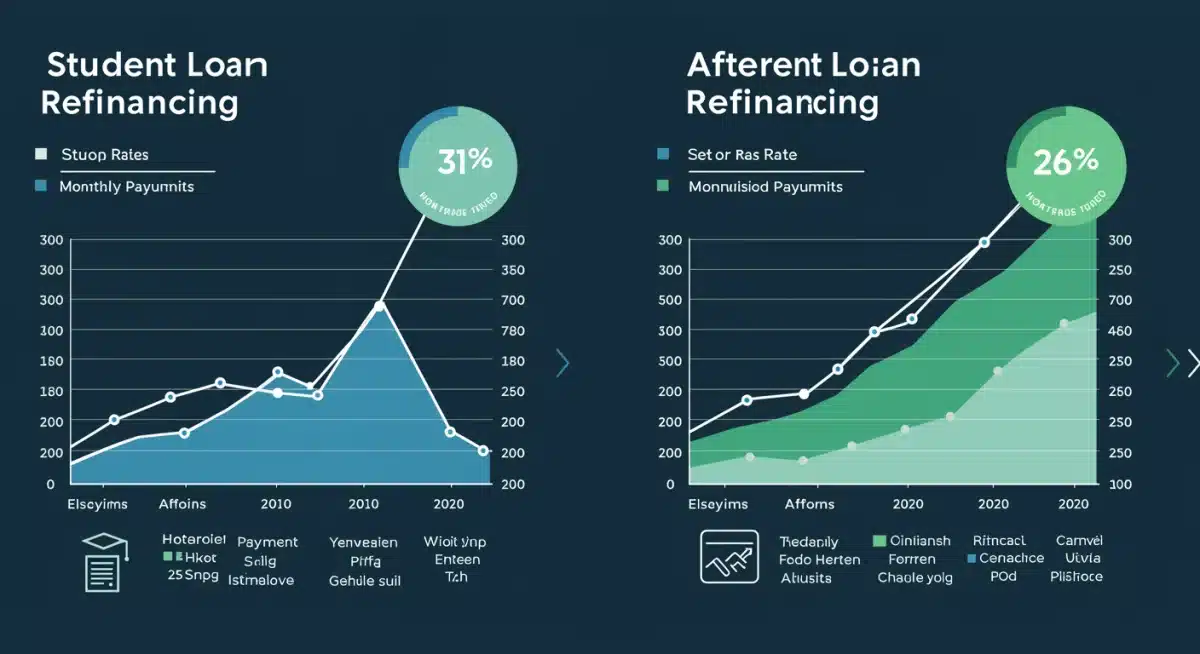
Furthermore, consider your future financial goals. Do you want to pay off your loans faster, or do you need lower monthly payments to free up cash flow? Refinancing can be tailored to either objective. If you plan to make a large purchase like a home, reducing your debt burden or monthly payments through refinancing could improve your eligibility for other loans. Ultimately, the optimal time is a confluence of favorable market conditions and your personal financial strength, making 2026 a potential year for significant savings if these factors align.
Eligibility requirements for student loan refinancing
Refinancing student loans is not universally available; lenders have specific criteria that borrowers must meet to qualify for new, lower-interest loans. Understanding these requirements is crucial for anyone considering refinancing in 2026, as meeting them will determine your eligibility and the terms you’re offered.
While requirements can vary slightly between lenders, there are common benchmarks that most financial institutions look for. These typically revolve around your financial stability, credit history, and the type of loans you wish to refinance.
Common qualifying factors
Most private lenders will assess several key areas to determine your eligibility and the interest rate they are willing to offer. Being prepared with strong credentials in these areas will give you the best chance for approval.
- Good to excellent credit score: As mentioned, a strong credit score (usually 670 or higher) is paramount. Lenders use this to gauge your reliability in repaying debts. The higher your score, the better your chances of securing the lowest rates.
- Stable income and employment: You’ll need to demonstrate a consistent income stream that is sufficient to cover your new loan payments, along with your other financial obligations. Lenders often require proof of employment and income, such as pay stubs or tax returns.
- Low debt-to-income (DTI) ratio: Your DTI ratio is a crucial indicator of your ability to manage additional debt. A DTI below 43% is generally considered favorable, but lower is always better.
- Graduation or degree completion: Many lenders require that you have already graduated with a bachelor’s degree or higher. Some may consider associate degrees or even a certain number of completed credits, but a degree often strengthens your application.
- U.S. citizenship or permanent residency: Most lenders require you to be a U.S. citizen or a permanent resident. Some may offer loans to international students with a qualified co-signer who meets these requirements.
Meeting these criteria positions you as a low-risk borrower, which is attractive to lenders and translates into better loan terms for you. If you don’t meet all the criteria, consider working on improving your credit or finding a co-signer.
In conclusion, the eligibility for refinancing student loans in 2026 hinges on a combination of strong credit, stable income, a manageable debt-to-income ratio, and often, degree completion. Preparing and improving these areas before applying will significantly enhance your chances of approval and securing favorable rates.
The step-by-step refinancing process in 2026
Navigating the student loan refinancing process can seem daunting, but breaking it down into manageable steps makes it much clearer. In 2026, the process remains largely streamlined, focusing on online applications and competitive rate shopping. Understanding each stage will help you move efficiently towards potentially saving thousands.
The journey typically begins with research and ends with the formal transfer of your loans. Being organized and proactive at each step is key to a successful refinancing experience.
A detailed guide to refinancing
Follow these steps to ensure a smooth and effective refinancing application. Each stage is important, so don’t rush through them.
- Research and compare lenders: Start by researching various private lenders. Look beyond just interest rates; consider their customer service, repayment options, and any fees. Many lenders offer a pre-qualification process that allows you to see potential rates without impacting your credit score.
- Gather necessary documents: Before formally applying, collect all required documentation. This typically includes proof of income (pay stubs, tax returns), loan statements for all existing student loans, identification, and proof of address. Having these ready will expedite your application.
- Submit your application: Once you’ve chosen a lender, complete their online application. Be thorough and accurate with all information. This step usually involves a hard credit inquiry, which may temporarily ding your credit score.
- Review and accept the loan offer: If approved, the lender will present you with a loan offer detailing the interest rate, monthly payment, and repayment term. Carefully review these terms. If you’re satisfied, accept the offer.
- Loan disbursement: The new lender will pay off your old student loans directly. This process can take a few weeks. Ensure you continue making payments on your old loans until you receive confirmation that they have been fully paid off to avoid any late fees or negative credit reporting.
The refinancing process culminates in your new loan taking effect, ideally with a lower interest rate and more manageable payments. Staying informed and prepared throughout these steps is essential for a successful outcome.
In essence, the refinancing process in 2026 involves careful research, meticulous document gathering, a formal application, and a thorough review of loan offers. By following these steps, you can effectively transition to a more favorable student loan agreement.
The benefits and potential drawbacks of refinancing
Refinancing student loans can be a powerful financial tool, offering significant advantages, but it also comes with potential downsides. It’s crucial for borrowers in 2026 to thoroughly understand both the benefits and drawbacks before making a decision, ensuring it aligns with their long-term financial strategy.
The allure of lower interest rates and reduced monthly payments is strong, but these gains must be weighed against the potential loss of federal loan protections.
Advantages of refinancing
The primary motivations for refinancing are often financial, aiming to make student loan debt more manageable and less costly over time.
- Lower interest rates: This is the most significant benefit. A lower rate means less money paid in interest over the life of the loan, leading to substantial savings.
- Reduced monthly payments: By lowering your interest rate or extending your repayment term, you can decrease your monthly payment, freeing up cash flow for other financial goals or necessities.
- Simplified payments: Consolidating multiple loans into one new loan means you only have one payment to track each month, simplifying your financial management.
- Pay off debt faster: If you secure a lower interest rate and keep your monthly payments the same (or even increase them slightly), more of your payment goes towards the principal, allowing you to pay off your debt sooner.
Potential drawbacks to consider
While the benefits are attractive, it’s vital to be aware of what you might be giving up, especially if you have federal student loans.
- Loss of federal loan benefits: Refinancing federal student loans into a private loan means forfeiting crucial protections like income-driven repayment plans, public service loan forgiveness (PSLF), generous deferment and forbearance options, and potential future government relief programs.
- No guarantee of lower rates: While the goal is a lower rate, it’s not guaranteed. If your credit score has worsened or market rates have risen, you might not qualify for a better deal.
- Application fees and closing costs: Some lenders may charge origination fees or other closing costs, which can eat into your savings. Always inquire about all associated fees.
- Extended repayment period: While a longer term can lower monthly payments, it might also mean paying more interest over the life of the loan, even with a lower rate, if the extension is significant.
Carefully evaluating these pros and cons against your personal financial situation and risk tolerance is essential. For some, the savings from a lower interest rate outweigh the loss of federal protections, while for others, the safety net of federal programs is indispensable.
In conclusion, refinancing student loans in 2026 offers compelling benefits like lower rates and simplified payments but requires a careful consideration of the trade-offs, particularly the loss of federal loan protections. A balanced assessment is key to making the best decision for your financial future.
Strategies for maximizing savings through refinancing
Once you’ve decided that refinancing student loans in 2026 is the right move for you, implementing smart strategies can significantly amplify your savings. It’s not just about securing a lower interest rate; it’s also about optimizing your repayment approach and continuously monitoring the market for even better opportunities.
Maximizing savings involves a combination of careful planning, proactive financial management, and leveraging market conditions to your advantage.
Optimizing your refinancing approach
To ensure you get the most out of your refinancing efforts, consider these strategic moves both before and after the process.
- Improve your credit score before applying: A few months before you plan to apply, focus on activities that boost your credit score. This includes paying bills on time, reducing credit card balances, and avoiding new credit applications. A higher score translates directly to better interest rates.
- Shop around aggressively: Don’t settle for the first offer. Apply to multiple lenders to compare rates and terms. Many lenders allow you to pre-qualify without a hard credit check, making it easy to gauge your options. This competition among lenders can work in your favor.
- Consider a shorter loan term: While a longer term means lower monthly payments, a shorter term will lead to significantly less interest paid over the life of the loan. If your budget allows, opt for the shortest term you can comfortably afford.
- Make extra payments: Even with a lower interest rate, making additional payments whenever possible will accelerate your debt payoff and further reduce the total interest paid. Direct these extra payments towards the principal.
- Refinance again if rates drop: The financial market is dynamic. If interest rates drop significantly after you’ve already refinanced, don’t hesitate to explore refinancing again. This is known as a “double refinance” and can lead to even greater savings.
These strategies empower you to take control of your student loan debt and turn refinancing into a truly powerful tool for financial liberation. Each step contributes to reducing your overall financial burden.
In conclusion, maximizing savings through student loan refinancing in 2026 goes beyond just getting a new loan. It involves strategic credit improvement, aggressive rate shopping, opting for shorter terms, making extra payments, and being open to refinancing multiple times as market conditions evolve.
Alternative debt relief options for student loans
While refinancing is an excellent option for many, it’s not the only path to managing student loan debt. For those who don’t qualify for refinancing or who prefer to retain federal loan benefits, several alternative debt relief options are available in 2026. Understanding these alternatives is crucial for making an informed decision that best suits your financial situation.
These options often provide flexibility and protection that private refinancing cannot, especially for federal loan borrowers facing financial hardship.
Exploring other avenues for relief
Consider these alternatives if refinancing doesn’t seem like the best fit for your current circumstances or financial goals.
- Income-driven repayment (IDR) plans: For federal student loan borrowers, IDR plans adjust your monthly payments based on your income and family size. After 20 or 25 years of payments (depending on the plan), any remaining balance is forgiven. These plans are invaluable for those with low income relative to their debt.
- Federal loan consolidation: As discussed earlier, federal consolidation combines multiple federal loans into one, simplifying payments and potentially opening the door to more IDR plans. It typically doesn’t lower your interest rate but can extend your repayment term.
- Deferment and forbearance: These options allow you to temporarily pause or reduce your student loan payments. Deferment is typically interest-free for subsidized loans, while forbearance usually accrues interest on all loan types. They are designed for periods of financial hardship, unemployment, or further education.
- Public Service Loan Forgiveness (PSLF): If you work for a government agency or a qualifying non-profit organization, PSLF can forgive the remaining balance on your Direct Loans after 120 qualifying monthly payments. This program has strict eligibility requirements but can be incredibly beneficial.
- Student loan assistance programs: Some states, professions (e.g., nurses, teachers), or employers offer their own loan repayment assistance programs. Research if you qualify for any of these niche programs, as they can provide significant relief.
Each of these alternatives offers a unique approach to managing student loan debt, catering to different needs and circumstances. It’s important to research each one thoroughly to determine which best aligns with your financial goals and current situation.
In conclusion, for those who find refinancing unsuitable, a range of alternative debt relief options for student loans exists in 2026, including income-driven repayment plans, federal consolidation, deferment, forbearance, and PSLF. Exploring these alternatives can provide much-needed flexibility and support.
Preparing for future student loan changes in 2026 and beyond
The landscape of student loans is constantly evolving, with potential legislative changes, economic shifts, and new programs on the horizon. For anyone with student loan debt, staying informed about these developments in 2026 and beyond is not just beneficial; it’s essential for proactive financial planning and maximizing your savings.
Anticipating future changes allows you to adapt your strategy, whether that means acting quickly on a refinancing opportunity or preparing for new federal relief programs.
Staying ahead of the curve
To effectively manage your student loans in the long term, consider these forward-looking strategies.
- Monitor legislative updates: Keep an eye on federal and state legislative discussions related to student loan reform, forgiveness programs, and interest rate policies. These changes can directly impact your repayment options and financial obligations.
- Track economic indicators: Interest rates are heavily influenced by economic factors like inflation, employment rates, and actions by the Federal Reserve. Understanding these indicators can help you anticipate shifts in refinancing rates.
- Review your financial situation regularly: Your income, credit score, and overall financial health can change over time. Periodically reassess your situation to see if you qualify for better refinancing terms or if alternative repayment plans have become more suitable.
- Maintain a strong financial profile: Continuously work on improving your credit score and maintaining a low debt-to-income ratio. A strong financial profile gives you more flexibility and better options, no matter how the student loan landscape changes.
- Consult financial advisors: A qualified financial advisor specializing in student loan debt can provide personalized guidance, helping you navigate complex decisions and stay informed about emerging opportunities or risks.
By adopting a proactive and informed approach, you can ensure that you are always in the best position to manage your student loans effectively, adapting to new challenges and seizing new opportunities for savings and relief.
In conclusion, preparing for future student loan changes in 2026 and beyond involves diligent monitoring of legislative and economic developments, regular personal financial reviews, and maintaining a strong financial profile. This proactive stance is crucial for long-term successful debt management.
| Key Aspect | Brief Description |
|---|---|
| Refinancing Goal | To secure a lower interest rate, reduce monthly payments, or shorten the loan term. |
| Optimal Timing | When market interest rates are low and personal credit/income are strong. |
| Eligibility Factors | Good credit score, stable income, low debt-to-income ratio, and often a degree. |
| Key Drawback | Loss of federal loan benefits like income-driven repayment or forgiveness programs. |
Frequently asked questions about student loan refinancing
The primary benefit of refinancing student loans in 2026 is securing a lower interest rate, which can significantly reduce your total repayment cost and potentially lower your monthly payments, freeing up more of your income for other financial goals or needs.
Yes, refinancing federal student loans into a private loan means you will lose access to federal benefits, including income-driven repayment plans, Public Service Loan Forgiveness (PSLF), and other federal forgiveness programs. This is a critical consideration before making the switch.
While requirements vary by lender, a good to excellent credit score, typically 670 or higher (ideally 700+), is usually needed to qualify for the most competitive interest rates when refinancing student loans. A strong score indicates financial reliability.
Yes, you can refinance student loans multiple times. If interest rates drop further after your initial refinance, or if your credit score improves significantly, you may be able to refinance again to secure an even lower rate and save more money over time.
Most reputable student loan refinancing lenders do not charge origination fees or prepayment penalties. However, it’s always wise to thoroughly review the loan agreement for any potential fees before signing, ensuring full transparency in the process.
Conclusion
Navigating the complexities of student loan debt can be challenging, but understanding your options, particularly the potential to refinance student loans in 2026, empowers you to take control. This guide has illuminated the key considerations, from optimal timing and eligibility to the step-by-step process and crucial trade-offs. By carefully assessing your financial situation, diligently researching lenders, and weighing the benefits against the loss of federal protections, you can make an informed decision that aligns with your long-term financial goals. Remember, proactive management and staying informed about market changes are your best allies in saving thousands and achieving greater financial freedom.