Podcast Analytics Deep Dive: 10% Content Optimization by Mid-2026
Anúncios
Understanding listener behavior through a comprehensive podcast analytics deep dive is crucial for achieving a targeted 10% content optimization by mid-2026, directly impacting audience engagement and growth.
Anúncios
In the rapidly evolving landscape of audio content, merely producing a podcast is no longer enough. To truly stand out and foster a loyal audience, creators must embrace the power of data. A podcast analytics deep dive is not just about counting downloads; it’s about dissecting listener behavior to uncover actionable insights that drive significant content optimization.
The evolving landscape of podcast analytics
The podcasting world is dynamic, with millions of shows vying for listener attention. In this competitive environment, understanding your audience is paramount. Podcast analytics has evolved significantly, moving beyond basic download numbers to offer sophisticated insights into listener demographics, engagement patterns, and content preferences.
Anúncios
For too long, podcast creators have operated with limited data, relying on intuition or anecdotal evidence. However, the tools and methodologies available today allow for a much more granular understanding of who is listening, how they are listening, and what resonates most with them. This shift from surface-level metrics to deep analytical insights is crucial for any show aiming for sustained growth and a loyal community.
Beyond basic downloads: what truly matters
While download numbers remain an important indicator of reach, they tell only a fraction of the story. A high download count doesn’t necessarily translate to high engagement or listener satisfaction. True understanding comes from examining metrics that reveal how listeners interact with your content.
- Listen-through rate: This metric indicates how much of your episode listeners complete. A high listen-through rate suggests compelling content that holds attention.
- Drop-off points: Identifying specific moments where listeners tune out can pinpoint areas for content improvement, whether it’s pacing, topic relevance, or audio quality.
- Audience demographics: Knowing your listeners’ age, gender, location, and interests allows for more targeted content creation and marketing efforts.
- Subscriber growth vs. one-time listens: Understanding the balance helps refine strategies for converting casual listeners into loyal subscribers.
The insights derived from these advanced metrics enable creators to move beyond guesswork. By analyzing these data points, podcasters can identify trends, understand what content resonates, and make informed decisions that lead to a more engaging and optimized listening experience. This level of detail is what truly empowers a 10% content optimization by mid-2026, setting a clear, measurable goal for improvement.
In conclusion, the modern podcast landscape demands a data-driven approach. Moving beyond simple download figures and embracing a holistic view of analytics provides the foundation for strategic content development and audience engagement.
Deconstructing listener behavior: key metrics and their impact
To achieve meaningful content optimization, it’s essential to dissect listener behavior through a careful examination of key performance indicators (KPIs). These metrics provide a window into how your audience consumes your content, offering invaluable data points for refinement and strategic planning.
Understanding the ‘why’ behind listener actions is just as important as knowing the ‘what.’ For instance, a sudden drop in listen-through rates for a particular segment might indicate a lack of engagement with that specific topic or guest. Conversely, consistently high retention rates for certain content formats suggest a winning formula worth replicating.
Unpacking engagement and retention data
Engagement metrics go beyond simple play counts. They delve into how deeply listeners interact with your show. Retention, on the other hand, measures how well you hold onto your audience over time. Both are critical for sustainable growth.
- Average consumption per episode: This metric provides a clear picture of how much of each episode your audience typically listens to. A low average could signal issues with episode length or content structure.
- Repeat listeners: Tracking how many listeners return for subsequent episodes is a direct measure of loyalty and satisfaction. High repeat listener numbers indicate a strong connection with your audience.
- Audience churn rate: This identifies the percentage of listeners who stop tuning in over a given period. Understanding churn allows for proactive strategies to re-engage or prevent loss.
These metrics, when analyzed collectively, paint a comprehensive picture of listener behavior. They help identify strengths to amplify and weaknesses to address. For example, if your repeat listener rate is low, you might need to re-evaluate your call to action or the consistency of your publishing schedule.
Moreover, analyzing these data points in conjunction with qualitative feedback, such as listener comments or social media engagement, can provide even richer insights. This blended approach ensures that data-driven decisions are also informed by the human element of your audience’s experience. Ultimately, deconstructing these behaviors allows for a more precise and effective content optimization strategy, moving you closer to that 10% improvement goal.
By focusing on these key metrics, podcasters can transform raw data into actionable intelligence, paving the way for content that truly resonates and retains its audience.
Leveraging audience demographics for targeted content
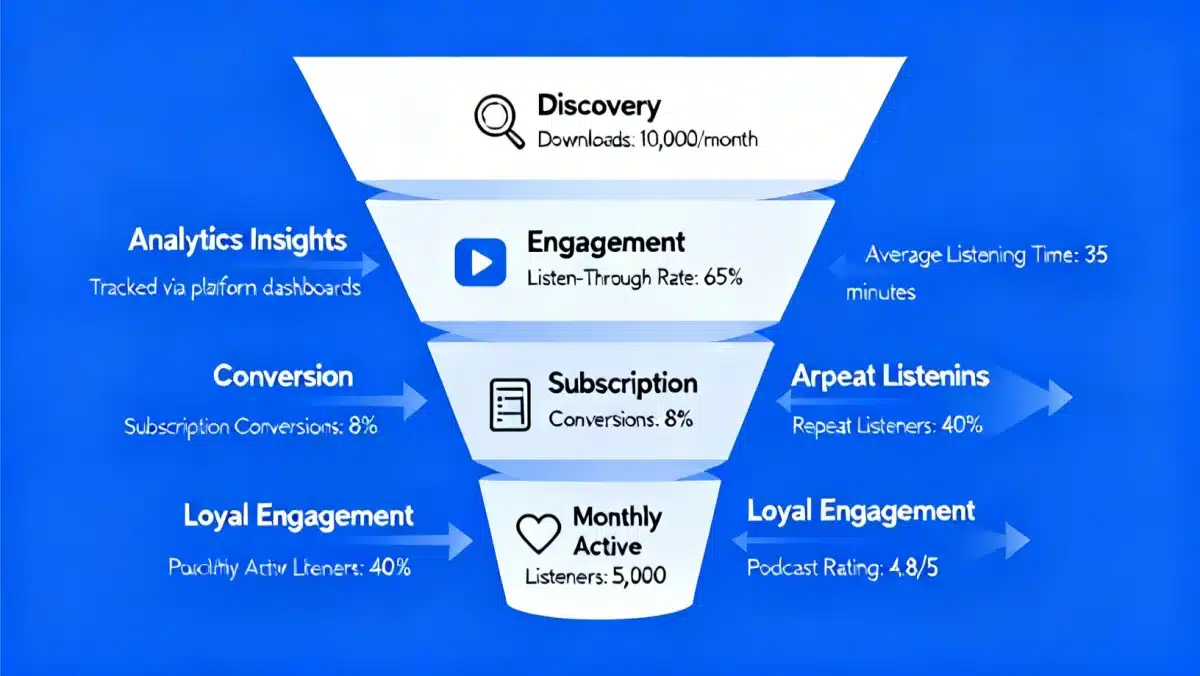
Understanding who your listeners are is fundamental to creating content that speaks directly to them. Audience demographics provide crucial insights into the characteristics of your listenership, enabling a more targeted and impactful content strategy. This goes beyond mere numbers, delving into the psychographics that define your audience’s interests, needs, and preferences.
When you know the age, gender, geographic location, and even the income brackets of your listeners, you can tailor your topics, language, and even your marketing efforts more effectively. This personalization is key to fostering a stronger connection and ensuring your content remains relevant and engaging.
Crafting personas from data
One of the most effective ways to utilize demographic data is by creating listener personas. These are semi-fictional representations of your ideal listeners, built from the aggregated data of your actual audience. Each persona should include details about their background, goals, challenges, and media consumption habits.
- Age and gender insights: How do different age groups perceive your content? Are there gender-specific topics that resonate more?
- Geographic distribution: Understanding where your listeners are located can influence local content, guest selection, or even episode release times.
- Interests and occupations: If your analytics reveal a strong listenership within a particular profession or hobby, you can tailor content to address their specific needs and interests.
- Device and platform usage: Knowing whether your audience primarily listens on mobile, desktop, or through specific podcast apps can inform technical optimizations and distribution strategies.
By developing these detailed personas, you can move from broad assumptions to precise, data-backed insights. This allows you to ask targeted questions: ‘What would Persona A find most valuable in this episode?’ or ‘How can we structure this segment to better appeal to Persona B?’
Furthermore, demographic data can highlight untapped audience segments or reveal that your current content is attracting a different audience than initially intended. This can lead to strategic pivots or the development of new content series designed to capture these emerging groups. The goal is to ensure that every creative decision is informed by a deep understanding of your audience, maximizing the potential for engagement and growth. This focused approach is a critical component of any successful podcast analytics deep dive, directly contributing to the ambitious goal of 10% content optimization by mid-2026.
Identifying content trends and optimizing formats
The effectiveness of a podcast is heavily influenced by its content and presentation format. A thorough podcast analytics deep dive allows creators to identify which topics, styles, and structures resonate most with their audience. This data-driven approach moves beyond subjective judgment, providing concrete evidence of what works and what doesn’t.
By analyzing performance metrics across different episodes and formats, podcasters can spot emerging trends in listener preference. This could involve anything from the popularity of interview-style episodes versus solo narratives, to the engagement levels with short-form versus long-form content. The key is to be agile and willing to adapt based on what the data reveals.
Analyzing episode performance and format preferences
Every episode is a data point, offering insights into listener behavior. Comparing the performance of different episodes can reveal patterns in content effectiveness. This analysis should consider various factors beyond just the topic.
- Topic popularity: Which subjects consistently generate higher downloads, longer listen-through rates, and more positive feedback?
- Guest impact: Do episodes featuring certain guests perform better? What characteristics do these guests share?
- Episode length: Is there an optimal length for your audience? Do shorter episodes have higher completion rates, or do longer, in-depth discussions retain listeners more effectively?
- Production style: How do different editing styles, music choices, or sound design elements affect listenership?
These insights are invaluable for refining your content strategy. For instance, if analytics show that listeners consistently drop off during a specific segment structure, you might consider experimenting with a different approach. Similarly, if a particular type of guest consistently boosts engagement, you can prioritize booking similar profiles in the future.
Optimizing content formats also extends to experimenting with new approaches. This could mean introducing mini-series, special bonus episodes, or even live Q&A sessions, all while closely monitoring their analytical performance. The goal is to continuously evolve your offering to meet and exceed listener expectations.
Ultimately, leveraging these trends and optimizing formats based on a comprehensive podcast analytics deep dive is a direct path to improving listener satisfaction and achieving that significant 10% content optimization by mid-2026. It ensures that your creative efforts are aligned with proven audience preferences, maximizing impact and reach.
Attribution and marketing effectiveness: connecting data to growth
One of the most challenging aspects of podcasting has traditionally been attributing growth to specific marketing efforts. However, advancements in podcast analytics are making it increasingly possible to connect listener acquisition directly to your promotional strategies. This allows for a more efficient allocation of resources and a clearer understanding of your return on investment.
Understanding which channels are most effective in bringing new listeners to your show is crucial for scaling your audience. Whether it’s through social media campaigns, cross-promotions with other podcasts, or paid advertisements, robust attribution data helps you refine your marketing mix and focus on what truly works.
Measuring campaign impact and listener acquisition
Effective marketing requires a clear picture of what drives listener acquisition. Modern analytics tools offer insights into where new listeners are coming from and how those sources influence their engagement with your content.
- Referral sources: Identifying websites, apps, or other podcasts that direct traffic to your show.
- Campaign-specific tracking: Using unique URLs or promotion codes for different marketing campaigns to measure their direct impact on downloads and subscriptions.
- Conversion rates: Analyzing how many listeners from a specific source convert into regular subscribers.
- Audience overlap: Understanding which other podcasts your audience listens to can inform partnership opportunities and cross-promotional strategies.
By meticulously tracking these metrics, podcasters can gain a clearer understanding of their marketing effectiveness. For example, if a particular social media campaign generates a high volume of downloads but a low listen-through rate, it might indicate that the messaging attracted the wrong audience, or that the content didn’t meet expectations set by the ad.
This data-driven approach to marketing allows for continuous optimization. Instead of guessing which promotional activities are most effective, you can make informed decisions based on tangible results. This iterative process of testing, measuring, and refining is essential for maximizing your growth potential.
Connecting attribution data with listener behavior metrics provides a holistic view of your audience’s journey from discovery to loyal listener. This comprehensive insight is a cornerstone of a successful podcast analytics deep dive, directly contributing to the overarching goal of 10% content optimization by mid-2026 through smarter, more targeted growth strategies.
Future-proofing your podcast: AI, predictive analytics, and emerging trends
The future of podcasting is intrinsically linked to technological advancements, particularly in artificial intelligence and predictive analytics. To stay ahead of the curve and maintain competitive edge, podcasters must begin to explore how these tools can further enhance their content and audience engagement strategies. This forward-looking approach ensures that content optimization efforts are not just reactive but also proactively positioned for future success.
Emerging trends suggest a shift towards even more personalized listening experiences, driven by sophisticated algorithms that understand individual preferences. Podcasters who embrace these technologies now will be better equipped to adapt to the evolving demands of their audience and the broader audio landscape.
Harnessing advanced tools for strategic foresight
AI and predictive analytics offer unprecedented opportunities for understanding and influencing listener behavior. These advanced tools can process vast amounts of data to identify patterns and forecast future trends, providing invaluable strategic foresight.
- AI-driven content recommendations: Utilizing AI to suggest topics or guests based on past listener engagement and broader content trends.
- Predictive audience segmentation: Foreseeing how different content types might appeal to various audience segments before production, allowing for proactive content development.
- Automated trend identification: AI can quickly spot micro-trends in listener preferences that might be missed by manual analysis, offering timely opportunities for content creation.
- Optimized scheduling and promotion: Using predictive models to determine the best times to release episodes or launch promotional campaigns for maximum impact.
By integrating these advanced tools into their analytics workflow, podcasters can move beyond simply reacting to past data. They can begin to anticipate listener needs and preferences, creating content that is not only relevant but also ahead of the curve. This proactive approach to content development is a game-changer, allowing for a more dynamic and responsive strategy.
Furthermore, staying abreast of broader industry trends, such as the rise of interactive audio formats or spatial audio, is crucial. While not directly analytics-driven, these trends influence listener expectations and provide new avenues for content delivery. A comprehensive podcast analytics deep dive will increasingly incorporate these external factors, ensuring that content optimization strategies are holistic and future-proof.
Embracing AI and predictive analytics is not just about gaining an advantage; it’s about securing the long-term viability and relevance of your podcast. This strategic foresight is key to achieving and sustaining that 10% content optimization by mid-2026 and beyond.
Implementing a 10% content optimization strategy by mid-2026
Achieving a significant 10% content optimization by mid-2026 requires a structured, data-driven approach. This isn’t a one-time adjustment but a continuous cycle of analysis, implementation, and refinement. The insights gleaned from a comprehensive podcast analytics deep dive must be translated into actionable strategies that directly impact content creation and delivery.
The goal is measurable improvement across key engagement metrics, leading to enhanced listener satisfaction and sustained growth. This involves setting clear objectives, defining specific actions, and establishing a robust system for tracking progress over time.
Actionable steps for measurable improvement
Translating analytical insights into tangible improvements requires a systematic approach. Each piece of data should inform a specific action designed to optimize your content.
- Set clear KPIs: Define what ‘10% optimization’ means for your podcast. Is it a 10% increase in average listen-through rate, a 10% reduction in churn, or a 10% boost in subscriber growth?
- Prioritize areas for improvement: Based on your analytics deep dive, identify 2-3 key areas that offer the greatest potential for impact. Focus your efforts here first.
- A/B testing content variations: Experiment with different episode lengths, intro/outro styles, segment structures, or even call-to-action placements and measure which performs better.
- Iterative content refinement: Implement changes based on your findings, then continue to monitor the data. This continuous feedback loop is essential for ongoing optimization.
- Engage with your audience: Use listener feedback, alongside analytics, to inform content decisions. Surveys, social media polls, and direct messages can provide valuable qualitative insights.
For example, if your analytics indicate a high drop-off rate after the first 5 minutes of an episode, an actionable step might be to experiment with a more engaging hook or to front-load the most compelling content. If a particular topic consistently underperforms, consider re-evaluating its relevance to your audience or adjusting your approach.
The 10% optimization target by mid-2026 is ambitious but achievable with a consistent, data-informed strategy. It compels podcasters to move beyond intuition and embrace the precision that analytics offers. This commitment to continuous improvement, guided by a thorough podcast analytics deep dive, is what will ultimately differentiate successful shows in a crowded market.
By meticulously implementing these steps, podcasters can ensure their content not only meets but exceeds listener expectations, driving significant growth and establishing a loyal, engaged community.
| Key Metric | Optimization Impact |
|---|---|
| Listen-Through Rate | Directly indicates content engagement; improving it enhances listener satisfaction. |
| Audience Demographics | Informs targeted content creation to resonate deeply with specific listener segments. |
| Drop-Off Points | Pinpoints exact moments where content loses attention, guiding precise edits and structural changes. |
| Referral Sources | Reveals effective marketing channels, optimizing listener acquisition and promotional spend. |
Frequently asked questions about podcast analytics
A podcast analytics deep dive is a comprehensive analysis of various listener data points beyond simple downloads. It examines metrics like listen-through rates, audience demographics, and drop-off points to gain actionable insights into listener behavior and content preferences, driving strategic optimization.
This goal is realistic because modern analytics tools provide granular data that enables precise identification of areas for improvement. With consistent application of data-driven insights and iterative adjustments, a 10% enhancement in key engagement metrics is achievable within a two-year timeframe.
Understanding demographics like age, location, and interests allows you to tailor content topics, language, and even cultural references to resonate more deeply with your specific audience. This personalization fosters stronger engagement and a more loyal listener base.
AI will revolutionize analytics by enabling predictive insights, automated trend identification, and hyper-personalized content recommendations. It will help podcasters anticipate listener needs, optimize scheduling, and identify micro-trends for proactive content development, ensuring future relevance.
Begin by selecting a robust analytics platform. Then, define your key performance indicators (KPIs), identify areas for improvement based on initial data, and start A/B testing small content variations. Continuously monitor results and refine your approach based on what the data reveals.
Conclusion
The journey towards a 10% content optimization by mid-2026 is not merely an aspiration but a strategic imperative for any podcast aiming for sustained success. By committing to a comprehensive podcast analytics deep dive, creators gain unparalleled insights into listener behavior, moving beyond guesswork to make data-informed decisions. This rigorous approach, encompassing everything from deconstructing engagement metrics and leveraging demographics to embracing future technologies like AI, empowers podcasters to refine their content, enhance listener satisfaction, and cultivate a truly engaged community. The future of podcasting belongs to those who listen not just to their audience, but also to the invaluable stories their data tells.