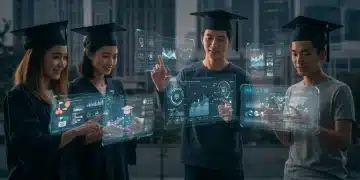
Future of Work & Education: 4 Critical Skills by 2026

Anúncios
The future of work and education by 2026 will profoundly reshape career paths, emphasizing critical thinking, advanced digital literacy, adaptability, and emotional intelligence as key competencies for success.
The landscape of employment and learning is undergoing a profound transformation. To thrive in this rapidly evolving environment, mastering future work education skills is not just an advantage, but a necessity. This article delves into the four critical skills young adults in the US must cultivate by 2026 to navigate this new era successfully.
Anúncios
Understanding the evolving job market
The global economy is currently experiencing unprecedented shifts, driven by technological advancements, automation, and a renewed focus on human-centric skills. This evolution is fundamentally altering job roles and creating new opportunities that demand a different set of competencies from the workforce.
Traditional career paths are being redefined, and continuous learning is becoming a cornerstone of professional growth. Employers are increasingly seeking individuals who can not only perform specific tasks but also adapt to new challenges and contribute to innovation. The pace of change requires a proactive approach to skill development, ensuring that today’s learners are prepared for tomorrow’s demands.
Anúncios
The impact of technology and automation
Automation, artificial intelligence, and machine learning are automating repetitive tasks, pushing human workers towards roles that require higher-order thinking and unique human capabilities. This doesn’t mean fewer jobs, but rather different kinds of jobs.
- AI integration in various industries
- Rise of data-driven decision making
- Need for human oversight in automated processes
Geopolitical and social influences
Beyond technology, global events, demographic shifts, and evolving social values also play a significant role in shaping the job market. The demand for sustainable practices, ethical considerations in business, and inclusive work environments are influencing hiring priorities and skill requirements.
Understanding these broader contexts is crucial for young adults to position themselves effectively in the future workforce. It’s about more than just technical skills; it’s about being a well-rounded and globally aware professional.
Skill 1: Critical thinking and complex problem-solving
In a world inundated with information and complex challenges, the ability to think critically and solve intricate problems stands out as an indispensable skill. This goes beyond simply identifying issues; it involves analyzing situations from multiple perspectives, evaluating evidence, and formulating innovative solutions.
By 2026, rote memorization will be largely irrelevant. Instead, employers will prioritize candidates who can dissect complex data, question assumptions, and develop creative strategies to overcome obstacles. This skill is foundational for navigating uncertainty and driving progress in any field.
Developing analytical abilities
Cultivating critical thinking begins with strengthening analytical abilities. This involves breaking down complex problems into smaller, manageable parts, identifying underlying causes, and understanding the relationships between different variables. It’s about moving beyond superficial observations to grasp the deeper implications of a situation.
Strategies for enhancing problem-solving
Active engagement with real-world scenarios, case studies, and collaborative projects are excellent ways to hone problem-solving skills. Practicing systematic approaches, like design thinking or root cause analysis, can provide frameworks for tackling diverse challenges effectively.
- Engage in debates and discussions
- Seek out diverse perspectives
- Practice logical reasoning exercises
- Analyze current events critically
The conclusion here is that critical thinking isn’t just about finding answers; it’s about asking the right questions, challenging the status quo, and developing robust solutions that stand the test of scrutiny. This skill will distinguish top performers in the future job market.
Skill 2: Digital literacy and technological fluency
The digital age is no longer a concept for the future; it is our present. For young adults, being merely familiar with technology is insufficient. True digital literacy involves a deep understanding of various digital tools, platforms, and their applications, as well as the ability to adapt to rapidly changing technological landscapes.
This skill encompasses everything from advanced software proficiency and data analysis to understanding cybersecurity basics and the ethical implications of digital technologies. By 2026, nearly every job will require some level of digital fluency, making it a universal prerequisite for employment.

Mastering essential digital tools
Beyond basic office software, proficiency in specialized tools relevant to various industries is becoming crucial. This could include project management software, data visualization tools, CRM systems, or even basic coding languages, depending on the career path.
Understanding data and algorithms
The ability to interpret data, understand how algorithms influence decision-making, and leverage data for strategic insights is a powerful asset. This doesn’t necessarily mean becoming a data scientist, but rather developing a data-informed mindset.
- Cloud computing fundamentals
- Basic coding for automation (e.g., Python, R)
- Data visualization techniques
- Cybersecurity awareness and best practices
Digital literacy is not a static skill; it requires continuous learning and adaptation. Staying curious about new technologies and engaging with them actively will be key to maintaining relevance in a digitally driven world.
Skill 3: Adaptability and resilience
If there’s one constant in the future of work, it is change. The ability to adapt to new circumstances, learn new skills quickly, and bounce back from setbacks (resilience) will be paramount. Economic shifts, technological disruptions, and evolving job requirements mean that individuals must be flexible and open to continuous transformation.
This skill set involves a growth mindset, where challenges are seen as opportunities for learning rather than insurmountable obstacles. Employers are looking for individuals who can pivot strategies, embrace new methodologies, and remain effective even in uncertain environments.
Embracing continuous learning
Lifelong learning is no longer a buzzword; it’s a career imperative. Actively seeking out opportunities to acquire new knowledge and skills, whether through formal education, online courses, or self-directed learning, will be essential for staying competitive.
Building mental toughness
Resilience is the capacity to recover quickly from difficulties. Developing mental toughness involves cultivating emotional regulation, self-awareness, and a positive outlook, even when faced with adversity. It’s about seeing failures as learning experiences.
- Develop a growth mindset
- Practice mindfulness and stress management
- Seek feedback and learn from mistakes
- Be open to new experiences and challenges
Adaptability and resilience are deeply intertwined. An adaptable person is often resilient, able to navigate changes without being overwhelmed. These qualities will be crucial for professional longevity and personal well-being in the dynamic future of work.
Skill 4: Emotional intelligence and collaboration
As technology takes over more routine tasks, the uniquely human skills of emotional intelligence and effective collaboration become even more valuable. Emotional intelligence involves understanding and managing one’s own emotions, as well as recognizing and influencing the emotions of others. This is critical for building strong relationships and fostering productive team environments.
Collaboration, in turn, is about working effectively with diverse individuals towards a common goal. This requires empathy, active listening, conflict resolution, and the ability to contribute positively to group dynamics. These interpersonal skills are increasingly recognized as drivers of innovation and organizational success.
Enhancing emotional awareness
Developing emotional intelligence starts with self-awareness – understanding your own feelings, strengths, and weaknesses. This leads to better self-management, allowing you to regulate emotions and behave constructively, even under pressure. Recognizing others’ emotions (empathy) is the next step, crucial for effective communication.
Fostering effective teamwork
True collaboration goes beyond simply working together; it involves mutual respect, clear communication, and a shared commitment to collective success. Learning to give and receive constructive feedback, mediate disagreements, and motivate team members are vital components.
- Practice active listening
- Develop empathy and perspective-taking
- Improve negotiation and conflict resolution skills
- Learn to give and receive constructive feedback
In conclusion, emotional intelligence and collaboration are not soft skills; they are power skills. They enable individuals to navigate complex social dynamics, build high-performing teams, and create inclusive work environments, which are essential for the future of work.
Integrating these skills into education
The traditional education system is often criticized for lagging behind the demands of the modern workforce. However, there’s a growing recognition of the need to integrate these critical skills into curricula from an early age, preparing students not just for exams, but for life and career success.
Educational institutions, from K-12 to higher education, are beginning to rethink their approaches, moving towards more project-based learning, interdisciplinary studies, and experiential opportunities that foster these essential competencies. The goal is to cultivate well-rounded individuals who are adaptable, critical thinkers, and effective collaborators.
Curriculum reform and modernization
Modernizing curricula involves more than just adding new subjects. It requires a fundamental shift in pedagogical methods, emphasizing active learning, problem-solving, and real-world application. This means moving away from passive information absorption towards dynamic engagement.
The role of experiential learning
Experiential learning, such as internships, apprenticeships, and community service projects, provides invaluable opportunities to apply theoretical knowledge in practical settings. These experiences are crucial for developing critical thinking, adaptability, and collaborative skills in a tangible way.
- Project-based learning initiatives
- Interdisciplinary studies
- Mentorship programs
- Simulations and real-world case studies
The integration of these skills into education is not just about preparing students for jobs; it’s about empowering them to become lifelong learners, innovators, and responsible citizens capable of shaping a better future. This holistic approach to education is vital for societal progress.
| Key Skill | Brief Description |
|---|---|
| Critical Thinking | Analyze complex information, evaluate evidence, and formulate innovative solutions. |
| Digital Literacy | Proficiency with digital tools, understanding data, and adapting to new technologies. |
| Adaptability & Resilience | Ability to adjust to change, learn new skills quickly, and bounce back from setbacks. |
| Emotional Intelligence | Understanding and managing emotions, effective communication, and collaboration. |
Frequently asked questions
These skills are critical because they address the core demands of an increasingly automated, data-driven, and interconnected world. They empower individuals to navigate complexity, leverage technology effectively, adapt to rapid changes, and collaborate meaningfully in diverse environments, ensuring long-term career viability.
Young adults can start by engaging in project-based learning, pursuing online courses in digital tools, seeking internships for real-world experience, practicing mindfulness for emotional intelligence, and participating actively in team sports or group projects to foster collaboration.
Traditional degrees remain valuable, but their focus is shifting. Employers now prioritize practical skills and continuous learning alongside academic qualifications. Degrees that integrate project-based learning, internships, and skill development are becoming more attractive in the evolving job market.
Employers have a crucial role in fostering skill development through training programs, mentorship, and creating a culture of continuous learning. Investing in their workforce’s upskilling and reskilling ensures their teams remain competitive and adaptable to future industry demands and innovations.
Emotional intelligence significantly impacts career progression by enabling stronger leadership, effective team collaboration, better conflict resolution, and improved communication. These qualities are highly valued in leadership roles and contribute to a positive, productive work environment, fostering professional growth.
Conclusion
The future of work and education is not a distant concept but a present reality that demands proactive engagement. By focusing on the development of critical thinking, digital literacy, adaptability, and emotional intelligence, young adults in the US can equip themselves with the essential tools to thrive in an ever-changing landscape. These four pillars of competency will not only open doors to new career opportunities but also foster personal growth and resilience, ensuring a successful and fulfilling journey into 2026 and beyond.